
More speed over the ground
At the same indicated airspeed, true airspeed is higher. For the same wind, so is groundspeed. There is more energy to manage and more landing distance to consider.

Designed by a pilot, for pilots
Expected approach performance for hot and high-elevation airports, ready for your briefing.
Coming soon to the App Store for iPhone and iPad
See it in action ↓“Hot and high” describes high temperature and high aerodrome elevation, which together reduce air density. Density altitude is the altitude in the standard atmosphere with that same density. The higher it is, the more your approach differs from a mild day at sea level.
At the same indicated airspeed, true airspeed is higher. For the same wind, so is groundspeed. There is more energy to manage and more landing distance to consider.
Holding the same path at a higher groundspeed means coming down faster. A tailwind adds to it.
Without temperature compensation, a Baro-VNAV path is steeper than charted on a warmer than standard day. The PAPI may show it.
Brake energy rises with the square of groundspeed, so a modest speed increase matters, especially on a short turnaround.
A VNAV approach with a 3.0° charted angle and PAPI, VAPP 145 kt, QNH 1013 and a 5 kt tailwind.
| Result | Sea level 15 °C | 5,500 ft 35 °C |
|---|---|---|
| Density altitude | 8 ft | 8,940 ft |
| True airspeed | 147 kt | 168 kt |
| Groundspeed | 152 kt | 173 kt |
| Vertical path angle | 3.00° | 3.33° |
| Rate of descent | 807 fpm | 1,021 fpm |
| PAPI | 2W 2R | 3W 1R |
| Brake energy | +0% | +30% |
Calculated with the app’s formulas. True airspeed, groundspeed and rate of descent are at 1,000 ft AAL. Brake energy compares touchdown with a sea level ISA landing in the same wind. Illustration only, not for operational use.
Swipe to look around.
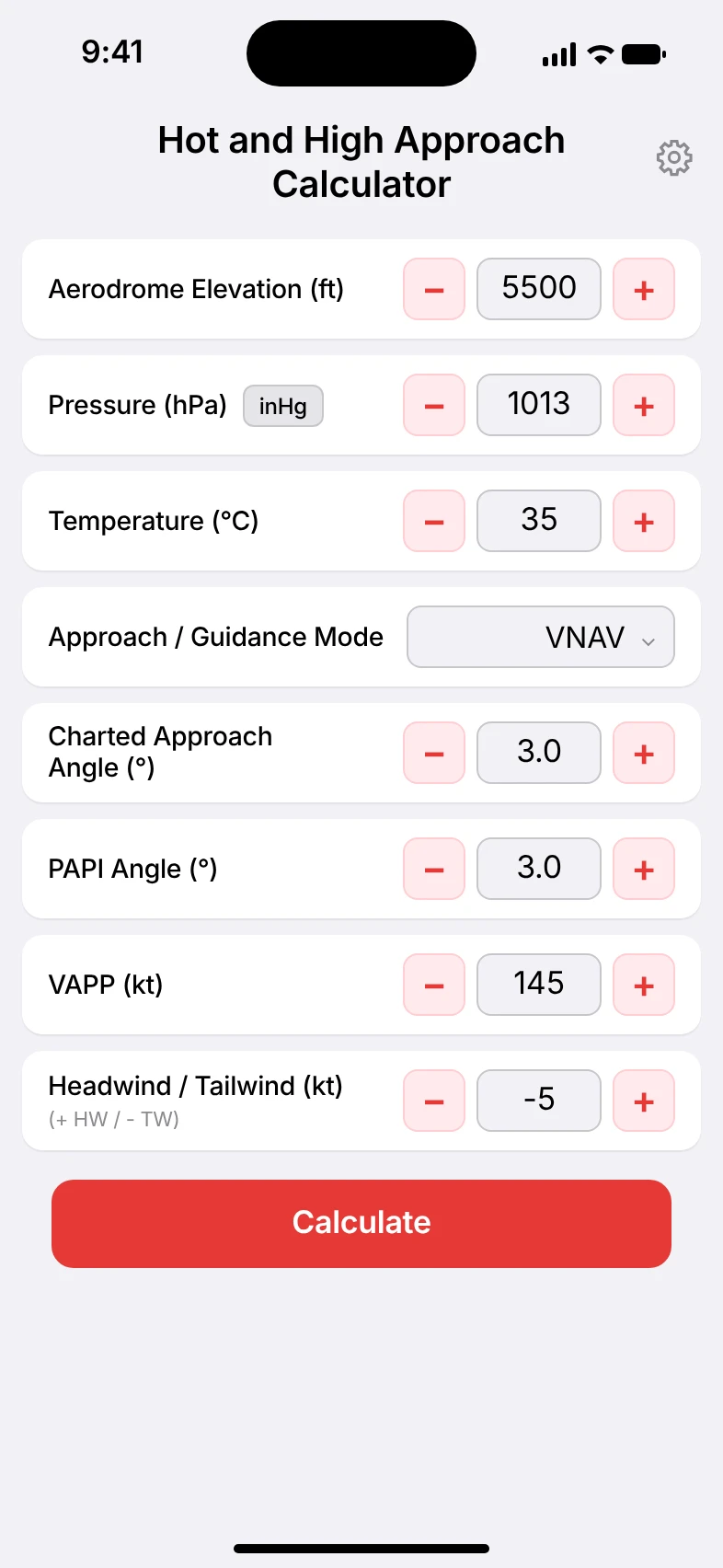
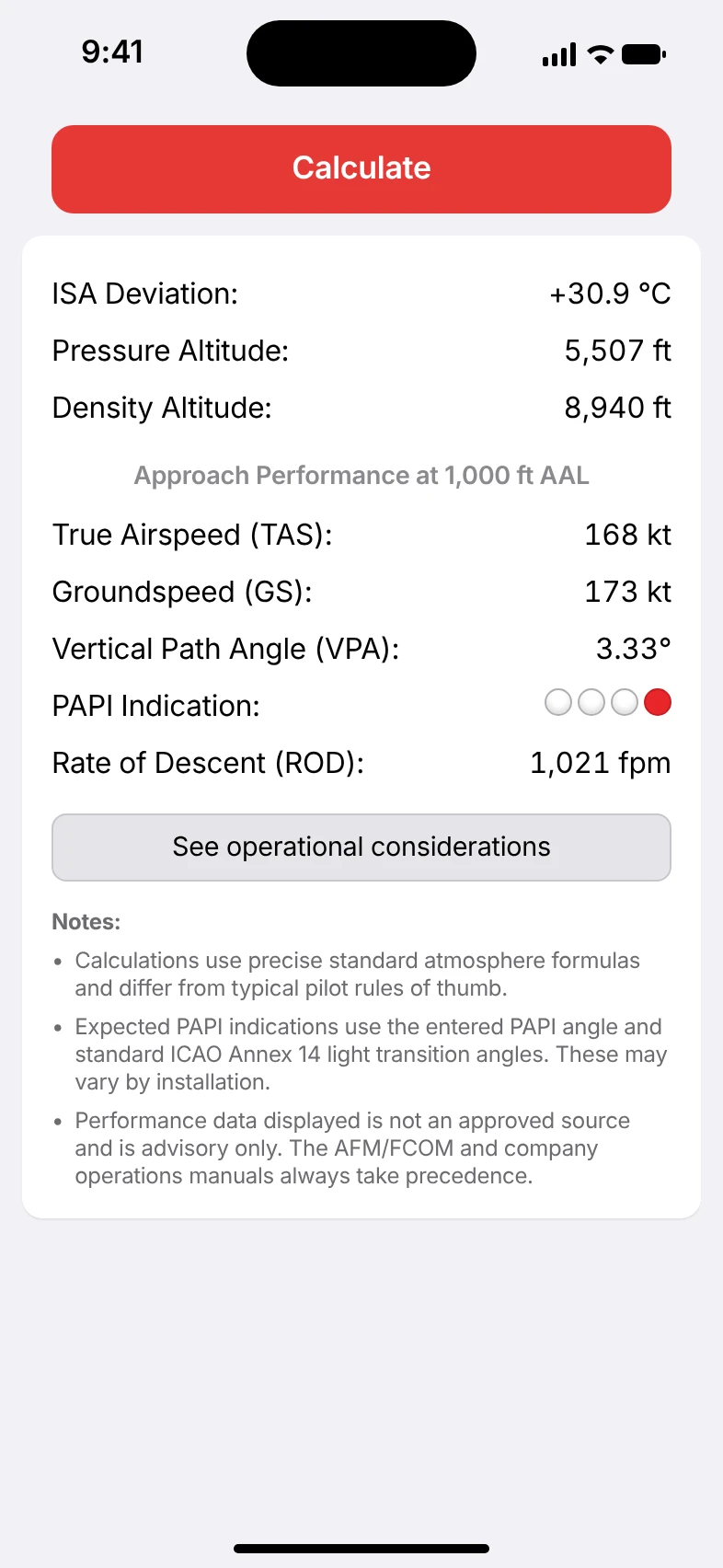
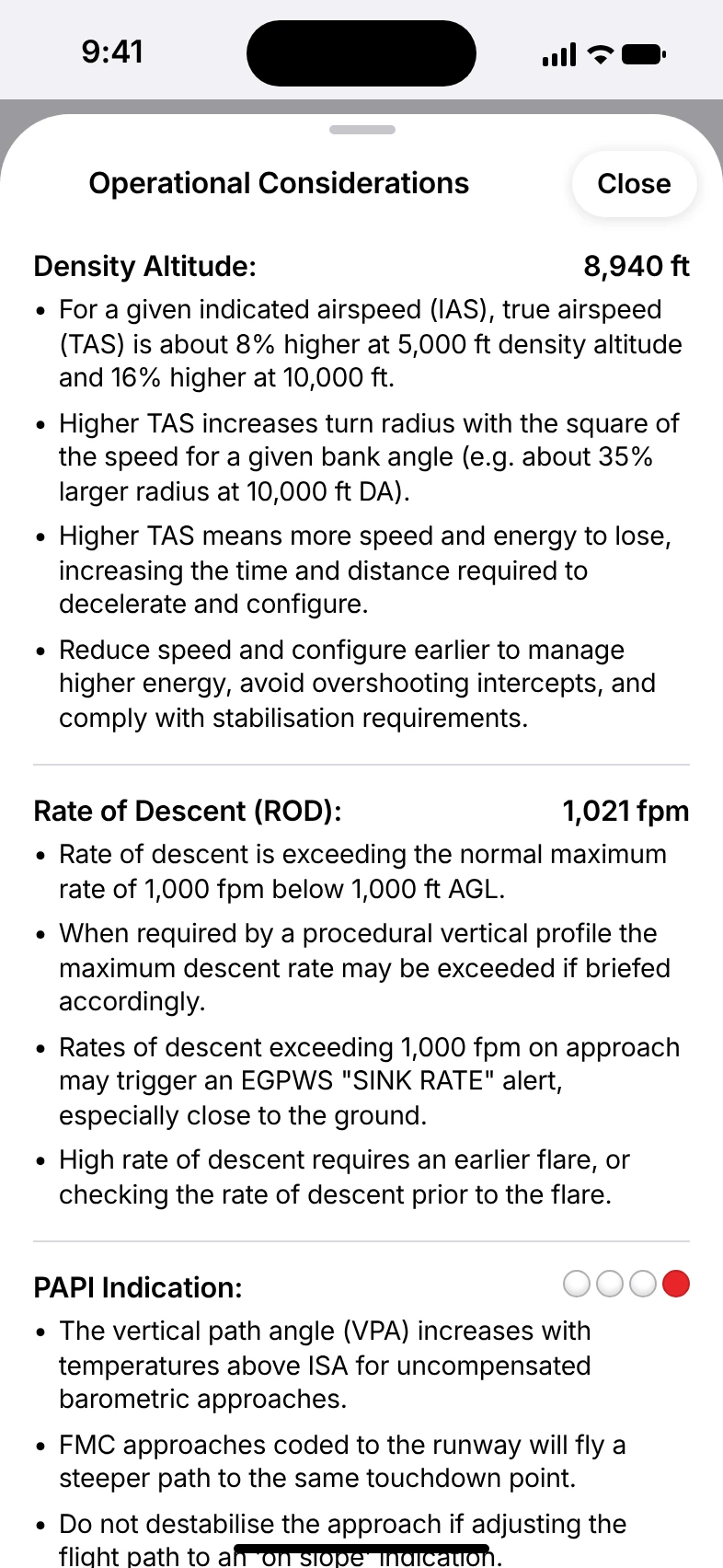
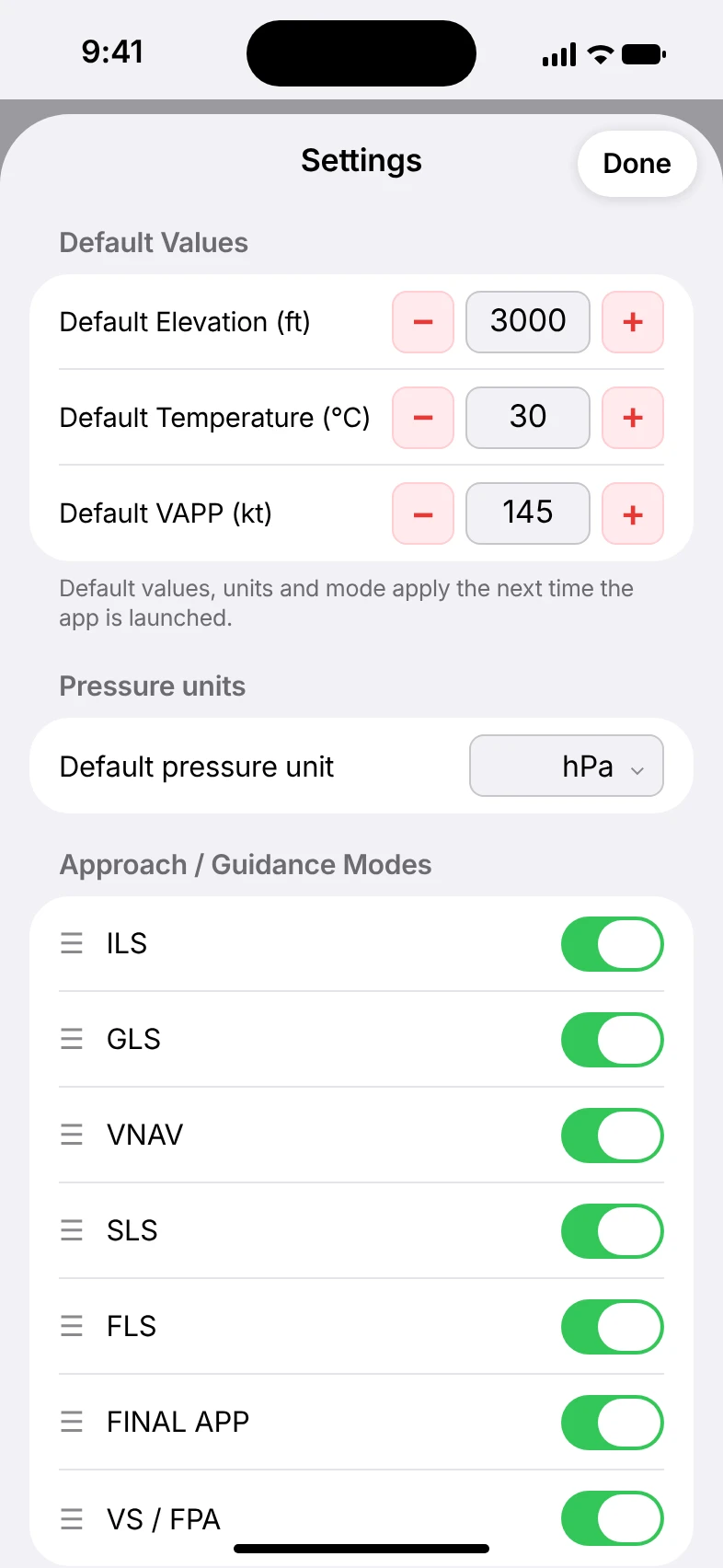
Screen illustrations. Appearance on your device may differ slightly.
This app provides advisory information. It is not approved flight performance software and does not replace the AFM, FCOM, company operations manuals or standard operating procedures. Results may differ from aircraft systems and approved data, and should be independently verified. Where any difference exists, approved documentation takes precedence. The pilot in command remains responsible for all operational decisions.